The Defensible AI Platform
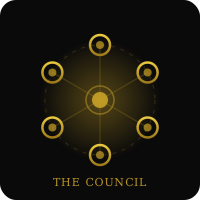
The Council
Multi-agent deliberation. Not a single model—an orchestrated system of specialized roles that challenge, dissent, and produce an auditable recommendation.
Why Single AI Models Fail for High-Stakes Decisions
Single-model chat can be useful, but high-stakes enterprise decisions fail for predictable reasons:
- Hallucination Risk: LLMs confidently generate plausible-sounding falsehoods, especially when dealing with edge cases or incomplete data
- Single Perspective Bias: One model trained on one dataset produces one viewpoint—it can't challenge its own assumptions
- No Internal Validation: Without adversarial challenge, models miss obvious problems that a second set of eyes would catch
- Untrackable Reasoning: When a single model makes a mistake, you can't trace where the logic broke down
- Accountability Vacuum: If the decision fails, who's responsible? The model? The prompt engineer? The executive who trusted it?
This is why regulated industries restrict AI chatbots for critical decisions unless outputs are governed, reviewable, and evidencable.
How The Council Works
The Council is a multi-agent deliberation system where specialized AI agents debate your decisions in structured rounds. Each agent has a specific role, knowledge domain, and challenge mandate. They analyze, argue, and synthesize until reaching consensus or escalating disagreement.
Note: Agents are roles (CFO, Legal, Risk, etc.) that share a configurable model stack; they are not 14 different foundation models. You can configure which agents participate and which local LLMs power them.
The Deliberation Process
When you submit a decision to The Council, here's what happens:
- Data Ingestion: The Analyst agent ingests all relevant data (documents, historical decisions, external signals)
- Initial Analysis: Specialized agents (CFO, CISO, Legal, Risk) independently analyze the decision from their domain perspective
- Adversarial Challenge: The Red Team deliberately attacks the analysis, simulating worst-case scenarios and regulatory blocks
- Debate Rounds: Agents exchange arguments in structured rounds, citing specific evidence from your data
- Dissent Tracking: CendiaDissent™ records every disagreement, who held which position, and why
- Synthesis: The Arbiter agent weighs all arguments and produces a final recommendation with verifiable decision trace
- Human Review: You receive the synthesis, all dissenting opinions, and the decision trace (inputs, citations, tool calls, approvals)
Unlike single-model chat, The Council is designed to surface and contain uncertainty: agents must cite evidence, disagreements are preserved, and outputs ship with a verifiable decision trace.
📦 What You Receive (Decision Packet)
Every Council deliberation produces an exportable decision packet containing:
📊 Recommendation
- Final recommendation with confidence bounds
- Key assumptions and thresholds
- Conditions for recommendation to change
📚 Evidence Citations
- Source documents + timestamps
- Retrieval context for each claim
- Data provenance chain
⚠️ Dissent Log
- Which agents disagreed and why
- Evidence each side cited
- What would change their position
🔧 Tool-Call Trace
- What tools ran, when, with what inputs
- Intermediate artifacts produced
- External system calls logged
✅ Approvals
- Human review sign-offs
- Policy gates passed/failed
- Escalation decisions
🔐 Integrity
- Run ID + timestamp
- Manifest of artifact hashes
- Optional cryptographic signature (KMS/HSM)
Meet The Agents



Real-World Scenarios
Mission 1: The M&A Deal
Context: Your investment team wants to acquire a SaaS company for $200M. The financials look solid, but something feels off.
Output: Risk-adjusted offer price with full reasoning chain. You didn't overpay by $80M.
Mission 2: The Supply Chain Shock
Context: Your primary semiconductor supplier just announced a 6-month delay. Production stops in 30 days.
Output: Rerouting strategy with contingency triggers. Production continues with 5% cost increase instead of total shutdown.
Single Model vs. Multi-Agent Comparison
| Capability | Single AI Model | The Council |
|---|---|---|
| Adversarial challenge | None | Built-in Red Team |
| Dissent tracking | No | CendiaDissent™ |
| Reasoning transparency | Summary only | Full debate transcript |
| Hallucination prevention | Prompt engineering | Multi-agent fact-checking |
| Accountability | Unclear | Agent-specific attribution |
| Regulatory audit trail | Prompt + response | Complete deliberation packet |
When Agents Disagree: CendiaDissent™
Not every decision reaches unanimous consensus. When agents fundamentally disagree, The Council doesn't hide the conflict—it documents it.
CendiaDissent tracks every disagreement:
- Which agents disagreed
- What positions they held
- What evidence each cited
- Why consensus couldn't be reached
- What would need to change for alignment
Why this matters: When your auditor asks "Did anyone question this decision before it was made?", you can hand them a cryptographically signable dissent record (customer-owned key / KMS-HSM integration available) showing exactly which concerns were raised, by whom, and why they were or weren't addressed.
In high-stakes decisions, documented dissent isn't a bug—it's proof of due diligence.
Frequently Asked Questions
How is this different from using multiple ChatGPT prompts?
Prompting ChatGPT multiple times with different personas gives you multiple independent answers, but no debate, no synthesis, and no adversarial challenge. The Council agents actively argue with each other, cite conflicting evidence, and force resolution. The debate transcript shows you where disagreements occurred and how they were resolved—or why they couldn't be.
Can I customize which agents participate?
Yes. You can activate specific agents for specific decision types. M&A decisions might use CFO, Legal, Risk, Red Team, and Arbiter. Product roadmap decisions might use Product, Engineering, Strategy, and Customer Success. The Council adapts to your decision context.
How long does a deliberation take?
Typical ranges: Simple decisions (approve/reject a vendor contract): 2-5 minutes. Complex decisions (M&A deal with 5,000 documents): 30-90 minutes. Actual time depends on model size, context length, retrieval depth, and document volume.
What happens if The Council reaches the wrong conclusion?
You have the decision trace showing which agent made which claim based on which evidence. You can trace exactly where the logic broke down, unlike single-model chat where errors are opaque. This traceability enables audit and review.
Does The Council work in air-gapped environments?
Yes. The Council runs entirely within your infrastructure. No vendor cloud LLM dependency—deliberation runs against local models (e.g., Ollama) inside your environment. This is critical for classified decisions or regulated environments where data can't leave your network.
⚠️ Limitations & Honest Disclosures
In the spirit of transparency, here's what The Council is not:
What The Council Is NOT
- Not a human replacement or autopilot — Approvals and policy gates remain required
- Not deterministic — Outputs can vary; we provide replayable run IDs and evidence exports
- Not "14 separate models" — Uses a configurable model stack (local-first), not 14 separate "brains"
- Not guaranteed — Constrained by data quality, integrations, and permissions
- Not magic — It's governance-aware automation with evidence
Technical Requirements
- Local LLM recommended — GPU preferred (Ollama with Qwen 2.5, Llama 3, Mistral)
- GPU: 16GB+ VRAM recommended for responsive multi-step workflows
- System: 32GB+ RAM, modern CPU, SSD storage
- Performance varies with model size, context length, retrieval depth, and tool calls
When It Works Well
- ✅ Structured scenarios (defined constraints, outcomes, thresholds)
- ✅ M&A / due diligence workflows
- ✅ Risk analysis and governance reviews
- ✅ Compliance responses grounded in documents and policies
Works best when inputs are structured, constraints are explicit, and outputs can be grounded in evidence.
When It May Struggle
- ❌ Novel edge cases without relevant evidence
- ❌ Highly specialized domains without curated sources
- ❌ Real-time decisions without live integrations
- ❌ Subjective/values-based choices requiring human judgment
Mitigation: add sources, define policies, integrate systems, require approvals
Bottom line: Augments human judgment—doesn't replace it. Outputs are accompanied by an exportable decision trace (inputs, sources, policies applied, approvals, run ID).
🛡️ How We Reduce Risk
Policy Gates + RBAC
Role-based access controls and policy enforcement at every step
Evidence Citations
Retrieval grounding with source attribution for every claim
Human Approvals
Veto authority and mandatory sign-off for high-stakes decisions
Decision Export
Audit packets with full deliberation trace, run IDs, and artifacts
See The Council in Action
Request a technical briefing to watch a live multi-agent deliberation on your decision scenario.
Request Briefing →Interested in the infrastructure? See our sovereignty deployment options or compliance framework mapping.